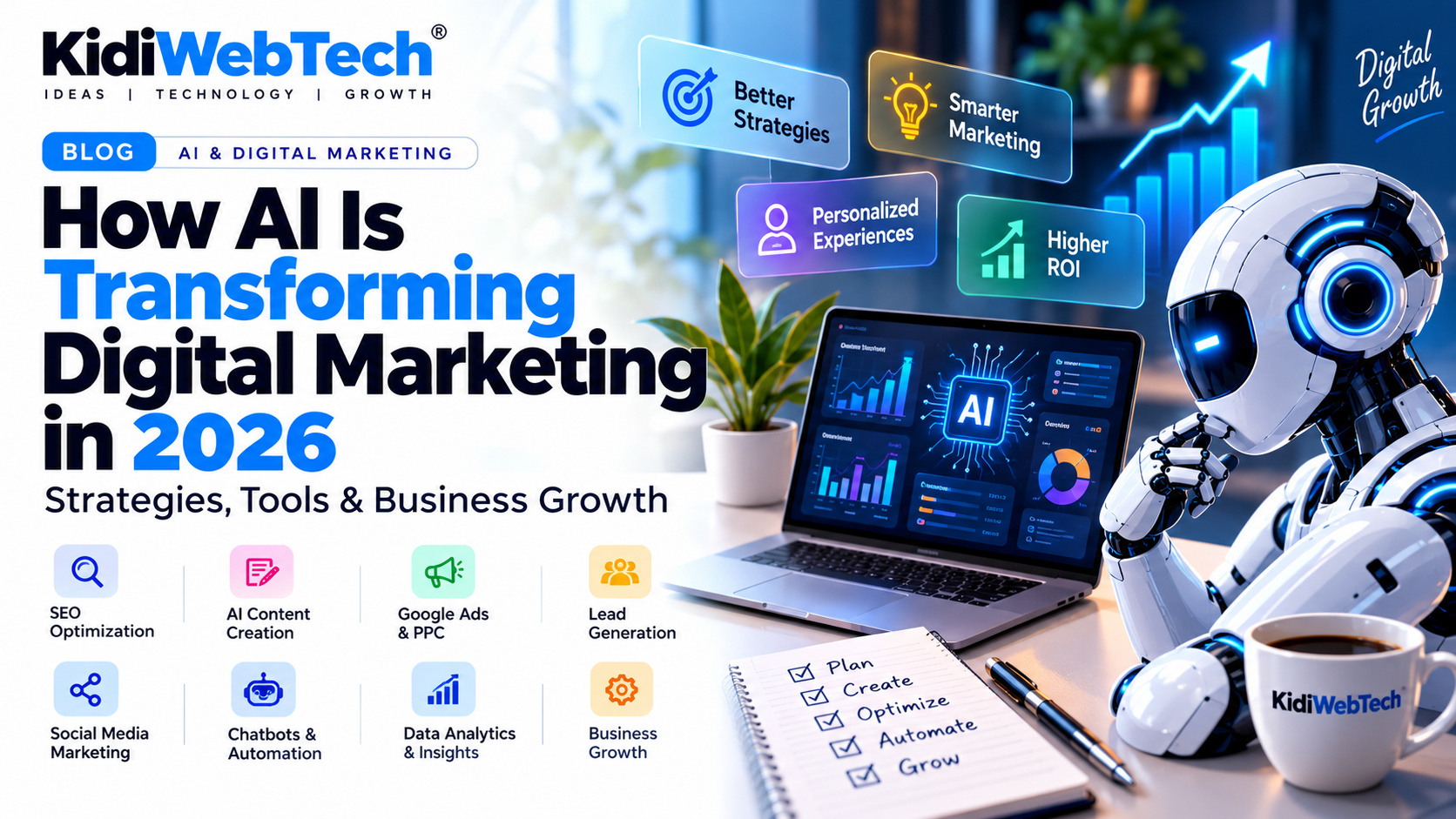
How AI Is Transforming Digital Marketing in 2026: Strategies, Tools & Business Growth
Artificial Intelligence (AI) is changing the way businesses attract customers, create content, optimize websites, generate leads, and build their brands online. In 2026, AI is no longer just a futuristic technology. It has become an important part of modern digital marketing strategies.
From AI-powered SEO and content creation to intelligent advertising and automated customer communication, businesses can use artificial intelligence to make marketing faster, smarter, and more personalized.
For businesses competing in highly competitive online markets, adopting the right AI digital marketing strategy can improve visibility, customer engagement, lead generation, and overall business growth.
What Is AI in Digital Marketing?
AI in digital marketing refers to using artificial intelligence technologies to analyze data, understand customer behavior, automate marketing activities, generate content, optimize campaigns, and make better marketing decisions.
Traditional marketing often depends on manual research and repetitive tasks. AI can process large amounts of information quickly and identify patterns that may be difficult to discover manually.
Businesses can use AI to support areas such as:
- Search engine optimization (SEO)
- Content creation
- Google Ads and paid advertising
- Social media marketing
- Lead generation
- Customer personalization
- Marketing analytics
- Chatbots and customer support
- Email marketing
- Website optimization
Why AI Is Important for Digital Marketing in 2026
The digital marketing environment is becoming increasingly competitive. Customers expect businesses to provide useful information, fast responses, personalized experiences, and convenient online interactions.
AI helps marketers handle these expectations while reducing repetitive manual work.
Instead of spending hours collecting and analyzing marketing data, businesses can use AI-powered systems to identify trends, understand audiences, generate ideas, and improve campaigns.
The biggest advantage is not simply automation. The real value of AI is helping businesses make better data-driven marketing decisions.
1. AI-Powered SEO
Search engine optimization continues to be one of the most important digital marketing strategies for businesses. AI can support SEO by helping marketers understand search intent, analyze content, discover keyword opportunities, identify technical issues, and develop content strategies.
AI can help businesses create topic clusters, identify content gaps, optimize headings and metadata, and improve the overall structure of web pages.
However, AI should support an SEO strategy rather than replace human expertise. High-quality content still needs accurate information, original insights, strong user experience, and genuine value.
2. AI Content Marketing
Content is one of the foundations of digital marketing. Businesses need website pages, blogs, social media posts, advertisements, emails, and other forms of content to communicate with their audiences.
AI can help marketers brainstorm topics, create content outlines, generate drafts, summarize information, and adapt content for different platforms.
The best approach is to combine AI with human expertise. AI can accelerate the content creation process, while experienced marketers can ensure that the final content is accurate, useful, original, and aligned with the brand.
3. AI for Personalized Marketing
Customers do not always respond to generic marketing messages. Personalization can make marketing communication more relevant to individual users.
AI can analyze customer interactions and behavior to help businesses deliver more relevant content, product recommendations, advertisements, and communication.
For example, an e-commerce business can use customer behavior data to recommend products based on previous interactions. A service business can use customer information to create more relevant campaigns.
4. AI-Powered Lead Generation
Generating quality leads is one of the biggest challenges for businesses. AI can help businesses improve lead generation by analyzing customer behavior and identifying potential customers.
AI-powered chatbots can answer common questions, collect contact information, qualify leads, and direct potential customers toward the next step.
When combined with a strong website, SEO, Google Ads, landing pages, and CRM systems, AI can create a more efficient lead-generation process.
5. AI and Google Ads
Paid advertising is another area where AI is becoming increasingly important. Modern advertising platforms use machine learning to analyze campaign performance and optimize delivery.
Businesses can also use AI to support keyword research, advertisement ideas, audience analysis, campaign planning, and performance analysis.
However, successful advertising still requires a clear strategy, accurate tracking, compelling landing pages, and continuous optimization.
6. AI Chatbots and Customer Support
Customers often expect businesses to respond quickly. AI chatbots can help businesses provide instant answers to frequently asked questions.
A chatbot can assist visitors with information about services, pricing, contact details, appointments, products, and other common questions.
This can reduce repetitive customer-support work while allowing businesses to provide assistance outside normal working hours.
7. AI for Social Media Marketing
Social media requires consistent content and regular audience engagement. AI can help marketers develop content ideas, create captions, analyze audience behavior, identify trends, and organize social media campaigns.
Businesses can use AI to create multiple content variations and then select and refine the best ideas for their audience.
Human creativity remains important because authentic storytelling and brand personality are essential for building trust on social media.
8. AI Analytics and Marketing Decisions
Marketing generates a large amount of data. Website visits, leads, conversions, advertising performance, customer interactions, and social media engagement can all provide valuable insights.
AI can help marketers analyze this information and identify patterns or opportunities.
Instead of simply asking how many visitors a website received, businesses can focus on more important questions such as:
- Which marketing channel generates the best leads?
- Which pages generate the most conversions?
- Which campaigns provide the best return on investment?
- Which customers are most likely to convert?
- Where are potential customers leaving the conversion funnel?
AI vs Traditional Digital Marketing
AI does not mean replacing traditional digital marketing. Instead, AI can improve existing marketing strategies.
| Traditional Marketing | AI-Powered Marketing |
|---|---|
| Manual data analysis | Automated data analysis |
| Generic campaigns | Personalized campaigns |
| Manual customer responses | AI-assisted responses |
| Time-consuming content research | Faster content research |
| Manual performance monitoring | Automated insights and reporting |
How Businesses Can Start Using AI
Businesses do not need to completely change their marketing strategy overnight. A better approach is to identify repetitive or data-heavy marketing activities where AI can provide measurable value.
A simple AI adoption strategy can include:
- Identify repetitive marketing tasks.
- Analyze your current website and marketing performance.
- Choose AI tools that match your business requirements.
- Use AI to support content and SEO research.
- Automate suitable customer communication.
- Use AI-assisted analytics to understand campaign performance.
- Continuously test and improve your marketing strategy.
Benefits of AI Digital Marketing
When implemented correctly, AI can provide several benefits for businesses.
- Faster marketing workflows: Automate repetitive tasks and reduce manual effort.
- Better customer personalization: Deliver more relevant experiences.
- Improved decision-making: Use data and insights to guide marketing strategies.
- Better lead generation: Identify and qualify potential customers more efficiently.
- Scalable content creation: Develop content ideas and drafts faster.
- Improved productivity: Allow marketing teams to focus on strategy and creativity.
- Better campaign optimization: Analyze performance and identify improvement opportunities.
The Future of AI and Digital Marketing
The future of digital marketing will increasingly combine human creativity with artificial intelligence. AI agents, automated workflows, predictive analytics, personalized experiences, and intelligent customer interactions are likely to become more common.
Businesses that learn how to use AI responsibly can create faster workflows while focusing more attention on strategy, creativity, customer experience, and business growth.
The goal should not be to use AI simply because it is trending. Businesses should use AI where it solves real problems and creates measurable value.
How KIDIWEBTECH Can Help Your Business
KIDIWEBTECH helps businesses build a stronger digital presence through SEO, website development, Google Ads, branding, digital marketing, and AI-powered solutions.
Businesses looking to build a fast, modern, responsive, and SEO-friendly online presence can explore our Website Development Services.
Our website development solutions are designed to help businesses establish a professional online presence, improve user experience, support SEO, and create a strong foundation for digital marketing campaigns.
From building a modern SEO-friendly website to developing digital marketing campaigns and AI-powered business solutions, our team focuses on creating strategies designed around business goals.
If you want to improve your online visibility, generate more leads, or explore how AI can be integrated into your marketing strategy, KIDIWEBTECH can help you create a practical digital growth plan.
Ready to take your digital marketing to the next level?
Contact KIDIWEBTECH for a Free Consultation
Frequently Asked Questions About AI Digital Marketing
What is AI digital marketing?
AI digital marketing uses artificial intelligence to support activities such as SEO, content creation, advertising, lead generation, personalization, analytics, and customer communication.
Can AI improve SEO?
Yes. AI can assist with keyword research, search-intent analysis, content planning, optimization, competitor research, and identifying content opportunities. Human expertise is still important for creating high-quality and useful content.
Can small businesses use AI marketing?
Yes. Small businesses can use AI for content ideas, customer support, lead qualification, marketing analysis, social media planning, and other repetitive tasks without needing a large marketing team.
Will AI replace digital marketing agencies?
AI is more likely to change how digital marketing agencies work than completely replace them. Strategy, creativity, brand understanding, technical expertise, and human decision-making remain important.
How can AI help generate leads?
AI can help businesses identify potential customers, personalize marketing campaigns, automate chatbot conversations, qualify leads, and analyze customer behavior.
Is AI content good for SEO?
AI can help create and organize content, but content should be accurate, useful, original, relevant to the audience, and reviewed by humans. Businesses should focus on providing genuine value rather than publishing large volumes of low-quality content.
Conclusion
AI is becoming an important part of modern digital marketing. From SEO and content marketing to advertising, analytics, personalization, and lead generation, artificial intelligence can help businesses work more efficiently and make better marketing decisions.
The businesses that succeed with AI will not necessarily be those that use the most tools. They will be the businesses that use AI strategically to solve real customer and marketing problems.
AI is changing digital marketing. The opportunity is to use it intelligently.